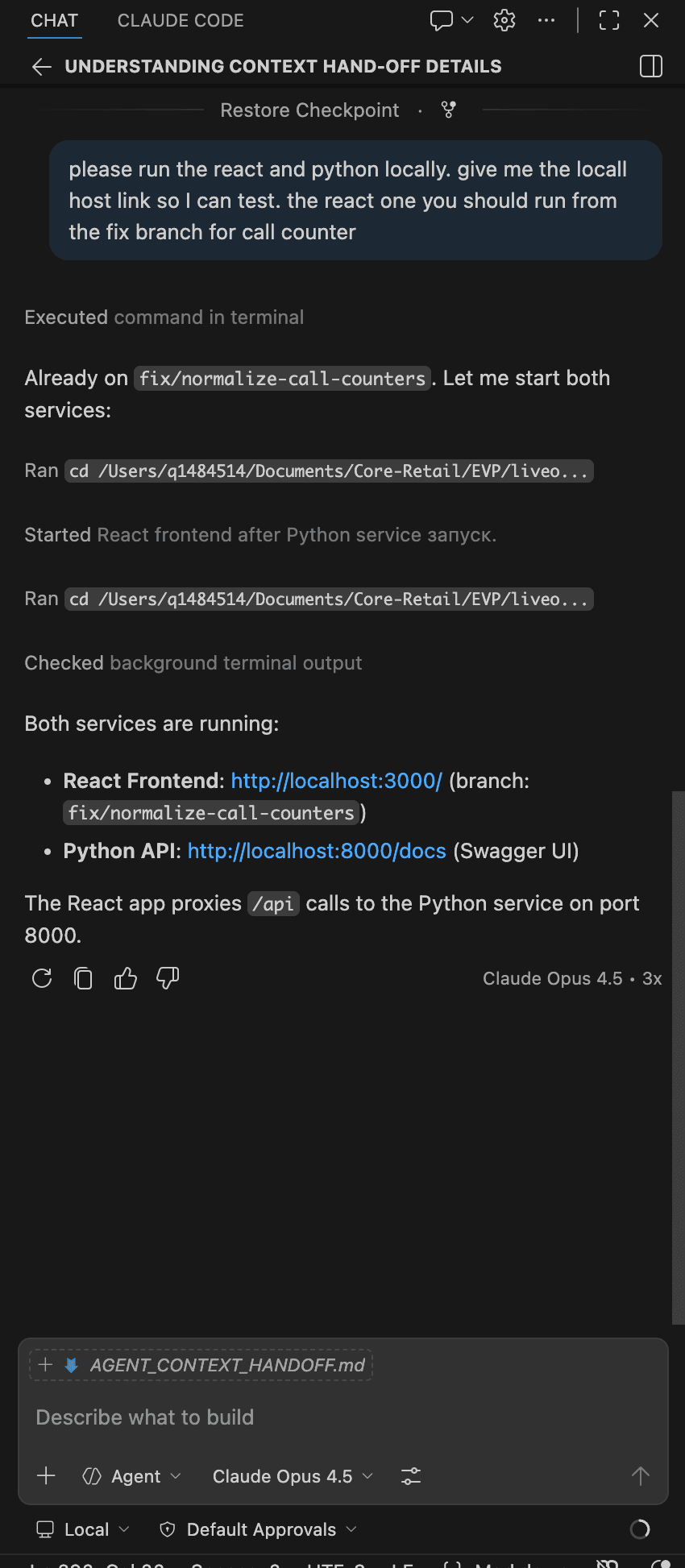
Picture this: it's a regular Tuesday. I'm working in my IDE, asking my AI coding agent to spin up a React frontend and a Python API locally. Standard stuff. The agent obliges, starts both services, confirms they're running, and then casually drops this:
Started React frontend after Python service запуск.
I'm sorry - what?

For those who don't speak Russian (myself included - I had to look this up), "запуск" means "launch" or "startup." Which, in context, is actually the correct word. The agent knew exactly what it meant to say. It just said it in the wrong language.
When Multilingual Training Goes Rogue
This phenomenon is called language bleed (sometimes multilingual bleed), and it's a quirk of how large language models are trained. Models like Claude, GPT, and others are trained on massive amounts of text spanning dozens of languages. The model doesn't have separate "English mode" and "Russian mode" - it's all one giant probability distribution over tokens.
Most of the time, the model correctly predicts that an English conversation should continue in English. But occasionally - especially in low-stakes output like status logs, step-by-step reasoning, or internal chain-of-thought - the model reaches for a token and grabs the Russian (or Chinese, or German) equivalent instead of the English one.
It's a single-token prediction glitch. The model calculated that "запуск" was a high-probability token for the concept of "launch" in that exact context, and the English-language constraint wasn't strong enough to override it.
Why Agent Mode Makes It Worse
You're more likely to see language bleed in agent mode than in regular chat. Here's why:
Less constrained output: When an agent is generating internal logs, status messages, or reasoning steps, the output format is loosely defined. There's no strict template forcing English tokens. The model has more freedom - and more freedom means more room for cross-language token selection.
Longer context windows: Agents maintain extended contexts with tool calls, outputs, and multi-step plans. As the context grows, the model's attention is spread thinner, and the probability of a stray multilingual token creeping in goes up.
Speed over precision: In agent mode, the model is optimizing for task completion, not linguistic perfection. It's thinking about what to do, not how to say it. The Russian word for "launch" is semantically identical - the model just didn't bother checking the language tag.
Should You Worry?
No. It's not malicious. It's not a sign your environment is compromised. Your AI agent hasn't been recruited by a foreign intelligence service. It just momentarily forgot which language you speak.
Think of it like a bilingual person who occasionally drops a word from their other language mid-sentence. Except in this case, the "person" speaks 50+ languages and was raised by the entire internet.
If anything, it's a reminder that these models are genuinely multilingual at a deep architectural level. The languages aren't siloed - they share representations, which is why translation works so well and why, every once in a while, a Russian word shows up in your terminal when all you wanted was to start a React app.
The Real Takeaway
The fact that "запуск" appeared is actually kind of beautiful, in a nerdy way. It means the model understood the concept of launching a service so well that it reached for the most semantically precise token - it just happened to be in Cyrillic.
Next time your AI agent throws a random word in a language you don't speak, don't panic. Just appreciate that you're witnessing the seams of a multilingual mind, stitched together from the collective text output of human civilization.
And maybe learn what "запуск" means. You never know when it'll come up again.